How Smart SMBs Automate Onboarding & Offboarding
The benefits of automation are well known to modern businesses. For decades, companies have found ways to turn slow, repetitive processes into efficient, self-executing systems. Which lets teams focus on impact, rather than repeating the same low-value tasks.
Onboarding and offboarding are both high-value processes made up of low-impact touchpoints. Getting team members up to speed quickly really matters. How you create their email account or reset security permissions doesn’t.
Which is why automating these manual steps makes such a big difference. Automated onboarding and offboarding takes low-value work off your plate, and lets you focus on what is important. It also makes both processes faster, easier, and eliminates basic errors.
In this article, we look at how automation can improve your onboarding and offboarding processes—particularly for IT operations. Then we meet two companies who successfully automated their own IT onboarding, and saw tangible benefits.
What are employee onboarding and offboarding processes?
Onboarding and offboarding are the practical, functional, and cultural processes associated with welcoming and farewelling company employees. Onboarding typically includes teaching new hires about the company culture, training in your specific ways of working, and giving them the hardware and software tools they need to execute.
Offboarding is the change process at the end of an employee’s time with your company. This can include exit interviews, farewell celebrations, and regaining possession of company property like computers, phones, and access cards.
Key steps in IT onboarding
The IT onboarding process is often slower than you’d like. It involves numerous distinct steps, which can really add up if handled individually and manually. These include:
- Setting up user profiles and permissions
- Ordering new devices
- Configuring applications, software, and security updates on these devices
- Delivering devices to new employees
- Training employees on compliance, cybersecurity, and optimal use
- Monitoring device performance and troubleshooting issues
IT is just one aspect of an employee’s onboarding, and can be taken for granted by hiring managers. Your goal is to make all of the above happen smoothly, quickly, and with no extra work for yourself or the new hire.
For help, see our short checklist for efficient IT onboarding.
What IT offboarding involves
While the IT onboarding process may be neglected, offboarding is often overlooked altogether. Retrieving devices from departing employees is essential both for asset management and security.
Key steps include:
• Locking devices the moment employees no longer need them
• Wiping personal data or returning devices to factory settings
• Returning physical devices to the office or supplier
• Checking a device’s state for reuse
• Preparing devices to be redeployed
All of this adds up, and is always more complicated with remote or distributed teams. In a traditional office setting, it’s pretty simple to have an employee hand in their devices on their last day. It’s more challenging if that employee is in another city, state, or country.
Why automate employee onboarding and offboarding?
In general, the best processes to automate involve a number of manual steps and little added value from having people handle each one.
Key benefits of automating your IT onboarding and offboarding include:
• Time saved for IT teams and hiring managers, who no longer need to manually work through each of those steps we saw above.
• Faster onboarding for new employees, who don’t need to wait for people to set up their profiles or order devices.
• Near-instant offboarding, because devices can be locked or wiped immediately with a simple click.
• Fewer errors, including skipped or forgotten steps, faulty devices, or losing track of devices when an employee leaves.
• More consistent experiences, as every employee follows the same automated process at the beginning and end of employment.
Overall, automation creates more streamlined and efficient internal processes. And for something as common and recurring as onboarding and offboarding, efficiency gains can really add up.
How modern SMBs automate onboarding and offboarding — and why it works
To illustrate with tangible examples, let’s take a look at two companies that prioritize automation in the onboarding and offboarding process.
Like many growing companies, both faced real challenges in scaling IT operations. Even as modern tech companies, they had few resources specifically for IT operations. They needed to create efficient, easily-replicable processes to get new employees up and running, and to smoothly offboard team members at the end of their work.
Best modern SMBs have understood that a great onboarding experience comes from the collaboration between HR and IT teams — and these two companies made that alignment a core part of their approach. As we’ll see, the secret to success lay in choosing the right tools and partners to take the weight off their very busy leaders.
Faume: Near-instant IT operations for a distributed workforce
Founded in 2020, Faume is a technical logistics solution that lets brands create resale services for their products. Faume works with world-famous logos like Hugo Boss, The Kooples, Aigle, and Bash to bring second lives to items and make consumer commerce more sustainable.
Faume’s 30-person team includes remote staff across France. CTO and Co-founder Jocelyn Kerbouc’h needed a simple way to deploy and manage devices for this distributed workforce ahead of scaling post-Series A.
Before: False starts with IT providers
Faume initially leased computers in the hopes of getting additional support and a streamlined service. But this was far more expensive than the cost of buying—they were asked to pay up to €2,500 for a €1,200 computer. And worse, they still regularly encountered malfunctioning devices and frustrating errors.
They pivoted to buying from Apple directly, tracking devices manually in a Notion doc. This was certainly more cost effective, but added more administrative effort to the onboarding process.
As a co-founder wearing multiple hats, Jocelyn couldn’t afford this extra admin. Faume needed a more robust IT operations solution that could deliver devices at the right price, while also tracking their use and ensuring security.
Today: Centralized IT onboarding & offboarding
The big switch was finding an IT operations provider that lets Jocelyn order, configure, and deliver employee devices in a few clicks. Using Primo, Jocelyn sets password rules and updates, and pre-configures applications so that computers arrive ready to use.
“Thanks to Primo, onboarding new employees now takes us half the time it used to,” says Jocelyn.
Faume has essentially automated the onboarding process, and offboarding is just as simple. When an employee leaves, Jocelyn can lock and wipe their computer remotely. Departing employees receive a shipping box and can easily return computers from anywhere.
The result is a more efficient, secure IT environment for Faume. And Jocelyn can put all his energy into building and leading his business.
Read the full Faume story here.
Dalma: Efficient operations with no IT team
Dalma is France’s fastest-growing pet health insurance company. Its tech-enabled platform already insures more than 40,000 European cats and dogs, with no signs of slowing down.
Founded in 2021, the 70-strong team has grown quickly to deliver this popular and worthwhile service. While that’s good for business (and for our pets), it put pressure on former Head of People Claire Maarek.
With IT onboarding just a small portion of her role, Claire didn’t have the time or technical expertise to build a comprehensive program from scratch.
Before: Poor leasing experience
Like Faume, Dalma also tried leasing as a (theoretically) efficient way to manage IT operations. But Claire explains that the downsides were obvious right away. “Our leasing experience was disappointing, offering minimal service and reliability with poor customer support.”
It was a maddening mix of high prices and low-quality service. For an HR leader like Claire—not an IT pro by trade—this wasn’t a tenable situation.
Today: IT onboarding in seconds
Since switching to Primo, the results are night and day. IT onboarding takes mere seconds, and Dalma can secure hardware at competitive prices, configured and delivered for when the person arrives. All of this with no deep IT procurement knowledge or dedicated technical experts.
Most importantly for HR professionals, Primo integrates with Payfit (alongside other HR platforms). Dalma adds a new employee in Payfit, and most of the process is automated from there. Devices arrive on time, whether new hires are in France or Germany.
When an employee leaves, Primo makes it easy to retrieve or reassign devices elsewhere, or simply resell them. Which makes both onboarding and offboarding as easy as can be.
Read the full Dalma story here.
Make IT onboarding and offboarding a breeze
Both IT onboarding and offboarding are relatively simple processes, made difficult by manual steps and a need for technical expertise. Particularly for growing companies without IT teams or paid external consultants, key steps can fall through the cracks.
That’s how you end up with security risks, sluggish processes, and frustrated team members — right when first impressions matter most.
The best way to streamline IT onboarding and offboarding is with one central solution. And as both Faume and Dalma showed, it’s even better when that solution integrates with your HR systems and company tools. This lets HR leaders and hiring managers—often “accidental IT managers”—keep control and ensure each step is completed efficiently.
Primo provides exactly that: an all-in-one IT management system for faster onboarding and offboarding. You can easily automate virtually all of your IT operations, without paying huge fees to managed providers.
Recommended articles

A new hire’s Day One says everything about how your company runs. If their laptop is on the table, configured, logged in, with the right apps installed — they feel set up. If the laptop is still in a courier’s warehouse and IT is scrambling to provision SSO — they feel like an afterthought, in their first six hours.
This is the IT onboarding checklist lean teams actually use. Five phases, RACI ownership, HRIS-triggered, mirrored for offboarding. Use it as your operating playbook, not a static doc.

The five phases, at a glance
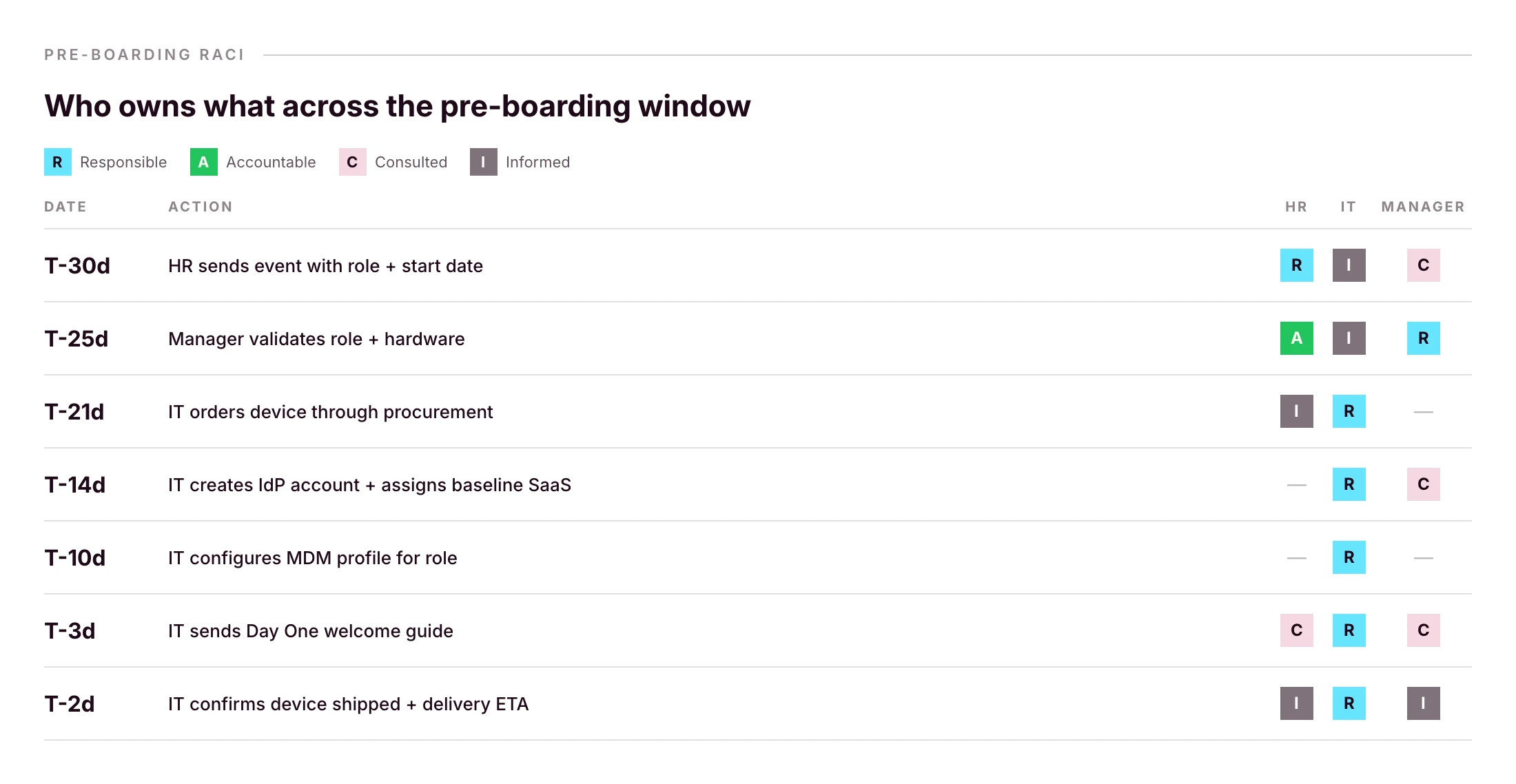
- Pre-boarding (weeks -4 to -1): order the device, create the IdP account, provision baseline SaaS by role, configure the device for delivery.
- Day One: device delivery, SSO login, MFA enrollment, EDR check, Acceptable Use Policy signature.
- Week One: verify every tool works, complete cybersecurity training, schedule first manager check-in.
- First 30 days: audit installed apps against role profile, document additional access requests, validate everything still works.
- Offboarding parity: set up the reverse workflow on Day One, not on exit day.
Each phase has owners, a timeline, and a measurable outcome. Done well, the whole flow runs in the background of an HRIS event. IT only gets pinged on exceptions.
Phase 1: Pre-boarding (weeks -4 to -1)
Most IT onboarding problems are pre-boarding problems. If the laptop is ordered late, Day One can’t be saved. If the IdP account is missing, the SSO chain breaks on first login.
HR-to-IT handoff (intake trigger)
The trigger should be the HRIS event, not a Slack message, not a calendar invite. The minimum payload IT needs to act:
- Full legal name and preferred name
- Start date and timezone
- Role and department
- Manager
- Work location and shipping address
- Hardware preference (if you offer choice)
If you’re capturing this in a Notion form or a Slack thread, you’re one departing teammate away from a gap. Make the HRIS the source of truth and pipe events into your IT workflow tool.
Order the device for direct-to-employee delivery
The window from order to first power-on is the most expensive part of IT onboarding when it goes wrong. Lead times for the EU vary by hardware and reseller; for international hires, add a week for customs.
The right pattern: order through a procurement workflow that ships the device pre-configured directly to the employee. If your platform supports zero-touch deployment, through Apple Business Manager or Windows Autopilot, the device finds your MDM automatically on first power-on, with no IT touch between order and Day One. Primo’s procurement workflow covers 60+ countries with delivery in around 5 business days, with apps and security pre-configured before shipping.
Create the user record in your IdP
Identity is the spine of everything that follows. The IdP account (Microsoft Entra ID, Google Workspace, JumpCloud, your federated IdP of choice) is what every SSO-enabled app will check against. Create it as soon as the HRIS event fires, not on Day One morning.
Provision baseline SaaS access by role
Group memberships in your IdP should map to roles, not individuals. “Designer” gets Figma, Notion, Slack, the design Drive. “Sales Rep” gets HubSpot, Gong, Slack, the sales Drive. Maintain the matrix once; reuse it for every hire.
Phase 2: Day One
A well-run Day One feels boring to IT and magical to the new hire. That’s the goal.
Device delivery and unboxing
If pre-boarding was done right, the new hire receives a sealed box, powers it on, connects to Wi-Fi, and watches the device configure itself. No IT presence required. This is the payoff of zero-touch deployment, and it’s the single most visible signal that your company runs operationally.
First login and SSO verification
The first login should be against your IdP. The new hire enters their company email, completes the IdP flow, and lands on a configured desktop. If they have to type a separate password into anything besides the IdP, your SSO chain has a gap. Fix it before Day One, not after.
MFA enrollment
Enroll the new hire into MFA during the first session. Use a phishing-resistant method (passkey, hardware key, or platform authenticator) wherever your IdP supports it. SMS-based MFA is below the line in 2026. Keep it as a fallback for account recovery only.
EDR agent and security policy check
Endpoint Detection and Response (EDR) should be installed by your MDM as part of the configuration push, not by the user. Verify in the admin console that the agent is reporting healthy before the new hire opens their first customer call. While you’re there, confirm disk encryption (FileVault, BitLocker), firewall, and idle-lock are all green.
Acceptable Use Policy signature
Push the AUP as part of the Day One flow, captured digitally with timestamp. Same for the phishing-awareness module assignment. This is the boring half of compliance, and the half that pays back during your next audit.
Phase 3: Week One and first 30 days
The first week is verification. The next 30 days is calibration.
In Week One, confirm every tool the new hire needs actually works: VPN, conferencing, email signature, calendar permissions, shared drive access, and the second-tier apps that came through the role profile. Schedule the first manager check-in for end-of-week-one, not later. Complete the cybersecurity training module.
In the first 30 days, audit the installed apps against the role profile and document every additional access request that came in. If a single role is generating 10+ ad-hoc access tickets in month one, the role profile is wrong, not the workflow. Fix the profile, not the ticket.
Use your HRIS as the trigger, not a spreadsheet
The single biggest upgrade you can make to IT onboarding isn’t a better checklist. It’s connecting your HRIS so the checklist runs itself.
When a new hire is created in an HRIS like BambooHR, HiBob, Factorial, Eurécia, Deel, Dayforce, Charlie, ADP or Gusto, the right remote device management platform should:
- Create the IdP account
- Order the device through the procurement workflow
- Pre-register the device to the OEM portal where supported
- Assign role-based MDM and SaaS policies
- Send the Day One welcome guide
- Alert IT only if something needs human intervention
This is the model behind Primo’s IAM page summary: “HR triggers it. Primo executes it.” Events flow from HR’s source of truth straight into device, identity and access workflows.
The win isn’t only speed. It’s parity: every new hire gets the same baseline, regardless of whether IT was busy that week.
Provision software and access by role, not app by app
If you’re provisioning SaaS access one app at a time, per hire, you’ve already lost the next ten hours.
The discipline that scales: define role profiles once, then map every new hire to a role. The role determines the apps, the permissions inside those apps, and the IdP groups they belong to.
Apply the Principle of Least Privilege as defined by NIST: each role gets only what’s needed to do the job. Run access reviews quarterly to catch role drift.
A minimal role-profile matrix:
- Designer: Figma, Notion, Slack, Drive. Editor on design assets, viewer elsewhere.
- Sales Rep: HubSpot, Gong, Slack, Drive. CRM rep view + own pipeline.
- Engineer: GitHub, Linear, Slack, Drive, AWS. Repo write on owned projects, AWS dev only.
Role profiles also make offboarding meaningful — you know exactly what to revoke, because you defined it once when you hired the role. Primo surfaces this directly as “Role-Based Access Control (RBAC) across every app”.
Procurement is part of onboarding
This is the part of IT onboarding most checklists skip, and most lean IT teams quietly burn weekend hours on.
A flawless Day One can’t recover from a laptop that arrives late, arrives unconfigured, or arrives at the wrong address. Procurement isn’t a separate vertical. It’s the first stage of onboarding.
For a lean IT team in 2026, procurement should cover:
- Sourcing through authorized resellers (so OEM zero-touch works where supported)
- International shipping with customs handled
- Pre-configuration before the box ships
- Asset tracking from purchase order through delivery
- Return labels generated automatically for the eventual offboarding
If your current setup is “IT lead orders devices manually, ships from home, types serial numbers into a spreadsheet” — that’s the part of the workflow with the highest return on automation. Primo’s procurement workflow handles this end-to-end: “From order to delivery, Primo ships, configures, and tracks every device automatically.”
Build one checklist for onboarding and offboarding
The most expensive part of offboarding isn’t the wipe. It’s the SaaS account nobody owned that quietly retains access for six months.
Every line on your onboarding checklist needs a mirror on your offboarding checklist. Build them at the same time, not on exit day.
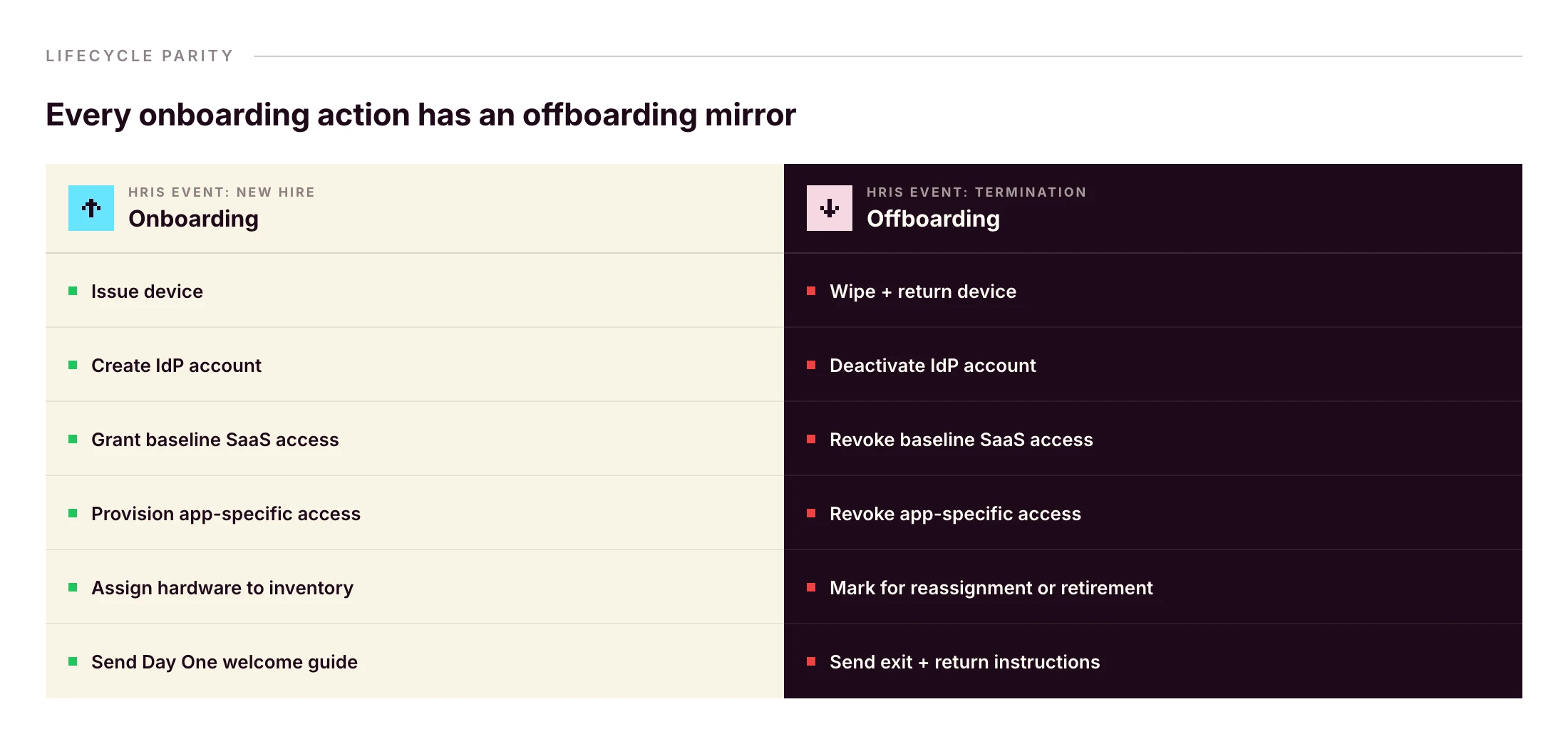
The same HRIS event that started onboarding can fire offboarding. Primo runs this as “Zero forgotten access. Ever. From first day to last, every account, seat, and permission is managed automatically.” and “Revoked automatically on their last day to prevent security breach.”
Without that pattern, a wiped laptop doesn’t reclaim Slack, Google Workspace, HubSpot, or Stripe. Identity and device have to be revoked together — same workflow, same trigger.
Frequently asked questions
What should be on an IT onboarding checklist?
A complete IT onboarding checklist covers pre-boarding (hardware ordering, account creation in the HRIS and IdP, baseline SaaS provisioning), Day One (device delivery, SSO login, MFA setup, EDR install, acceptable use policy signature), and the first 30 days (training, tool verification, access audits). It should also establish offboarding parity from day one.
What is the difference between IT onboarding and HR onboarding?
HR onboarding covers contracts, payroll, benefits, culture and orientation. IT onboarding covers everything the new hire needs to work on Day One: hardware, accounts, applications, security setup and policies. In practice the two should be triggered from the same HRIS event so they stay in sync.
When should IT onboarding start?
IT onboarding should start at least two to four weeks before the new hire’s first day. That window covers hardware ordering and shipping, account creation in the IdP, baseline SaaS provisioning, and any zero-touch deployment configuration. For remote international hires, add another one to two weeks for customs and delivery.
What does a new hire need on Day One?
A configured laptop, working SSO login, MFA enrolled, email and chat access, calendar synced, role-based app access, an installed EDR agent, and a signed acceptable use policy. They also need a working manager check-in and a help channel for IT issues.
How do you onboard a remote employee?
Ship a pre-configured device using zero-touch deployment. Trigger account creation from the HRIS so credentials are ready on Day One. Provide a written Day One guide. Schedule a video onboarding call with IT and the manager. Verify SSO, VPN and MFA remotely. Set up a clear escalation channel for first-week issues.
How long should IT onboarding take?
Pre-boarding spans two to four weeks. Day One setup should take under an hour for the employee if zero-touch deployment is in place. The full onboarding cycle, including training, access audits and role validation, typically runs 30 days. Anything longer suggests manual handoffs in the IT-HR workflow.
Who is responsible for IT onboarding?
On lean teams responsibility is shared: HR or the hiring manager triggers the workflow, IT executes provisioning, and the manager validates role-specific access. A RACI matrix prevents gaps. On smaller teams without a dedicated IT person, an HR or office operations lead often owns the IT onboarding workflow.
See an HRIS-triggered onboarding flow that handles device, identity and access from one console, with offboarding parity built in.
Remote device management (RDM) is the practice of monitoring, configuring and securing devices from a central console without physical access. Lean IT teams use it to enroll laptops, phones and tablets across macOS, Windows, Linux, iOS and Android, push software and policies, automate patching, and lock or wipe devices remotely — all without sending an IT lead to a desk.
This is the operating model that makes distributed teams possible. Below: what RDM covers in 2026, how it relates to MDM, RMM and UEM, and how to evaluate a platform when you're running IT for a 50–2,000 employee company.
What remote device management covers
The six core pillars:
• Provisioning: enrolling a device and pushing a baseline configuration
• Telemetry: inventory, health and compliance data collected in the background
• Remote access: viewing or controlling a device, where the OS allows it, with the user's consent
• Patch management: keeping the OS and apps up to date on a defined cadence
• Policy enforcement: encryption, password rules, firewall, conditional access
• Lock and wipe: recovering or destroying data on a lost, stolen or returned device
A serious RDM platform delivers all six in one console, not split across three vendors. That single-console claim is what separates platforms built for the SMB operator from enterprise tools that scale down poorly.
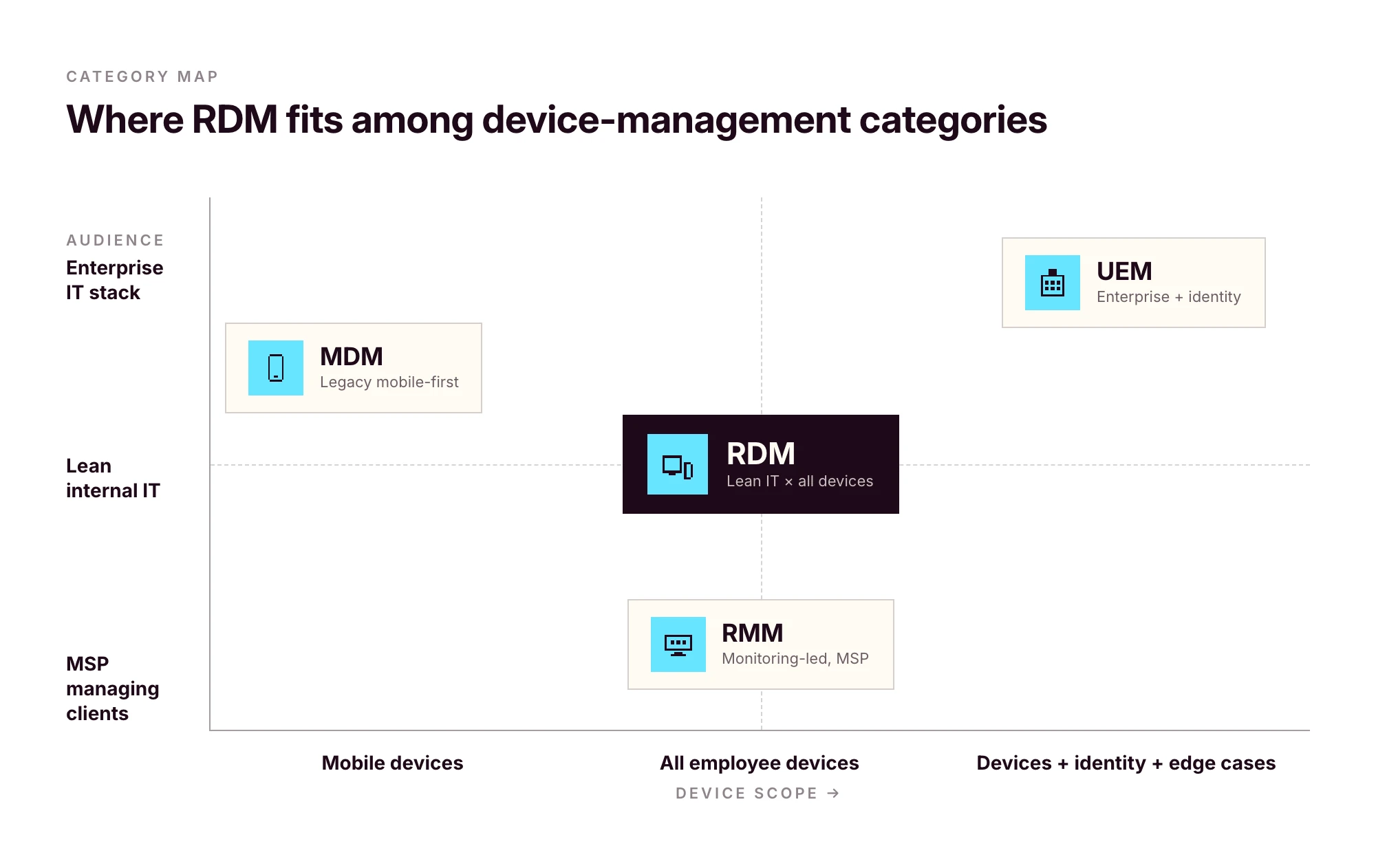
RDM vs MDM vs RMM vs UEM
The acronyms have drifted over the last decade. Vendors use them interchangeably; the original definitions still help.
In practice, most modern MDM platforms function as full RDM systems, and UEM has become a marketing label that often means "MDM plus identity." For an SMB, the practical question isn't the label — it's whether the platform covers every OS you run, integrates with your HRIS and identity provider, and handles the full device lifecycle.
If a vendor's "MDM" only covers Apple, it isn't RDM. If a vendor's "UEM" needs a six-month enterprise rollout, it isn't built for you.
What modern remote device management software actually does
A modern RDM platform should give you the following without third-party agents bolted on.
Remote view, with the user's consent
Screen sharing for support. Standard on macOS and Windows. Unattended remote control depends on OS permissions and consent prompts. iOS in particular restricts unattended control by design, and any platform claiming otherwise is overselling.
Remote scripting and terminal
Shell access (SSH on macOS/Linux, PowerShell on Windows) for diagnostics and remediation at scale. On Linux endpoints, this is also how most fleet management gets done in practice, scripts, inventory checks, configuration management, since GUI-driven control is OS-dependent.
Background telemetry
Hardware inventory, installed apps, OS version, encryption status, last seen, last user. Refreshed automatically. The first time a laptop goes missing or an auditor asks for an asset list, this data pays for itself.
Patch management
Automated OS and third-party app updates with deferral windows. A critical security patch can't be silently ignored. A non-critical update can't disrupt someone mid-customer-call.
Policy enforcement
Disk encryption (FileVault on macOS, BitLocker on Windows, LUKS on Linux), password complexity, idle-lock, firewall, USB restrictions. Pushed once, enforced everywhere.
Lock and wipe
Two flavours. Full wipe for company-owned devices being decommissioned. Selective approaches for BYOD: on macOS, Account-Driven User Enrollment cleans only managed data; on Windows, Intune App Protection Policies do similar work for managed apps; on Android, Work Profiles isolate corporate data so it can be removed without touching the personal side. The right pattern depends on ownership and OS — your RDM should support all of them.
Role-based access governance
A point most teams overlook until they hire their second IT admin. Strong RDM platforms enforce role-based access governance in two distinct places: across the SaaS apps the platform provisions, and on the management console itself. Primo states the first explicitly: "Role-Based Access Control (RBAC) across every app", with policies tied to roles instead of individuals. Confirm with any vendor that the same governance applies to who can wipe a device or run a remote script inside the admin console, not just to the apps the platform manages. SSO on the console matters for the same reason: when an admin leaves, their management access should die with their identity record.
Multi-OS coverage: the operating system matrix
This is where most vendors fall short. Apple-only platforms (Jamf, Mosyle) skip Windows and Linux. Windows-led platforms (Intune) treat Macs as second-class. The cost of stitching three tools together (three contracts, three consoles, policies that drift) stays invisible until you're the one keeping them in sync.
Sanity-check what's actually possible per OS before evaluating any platform.
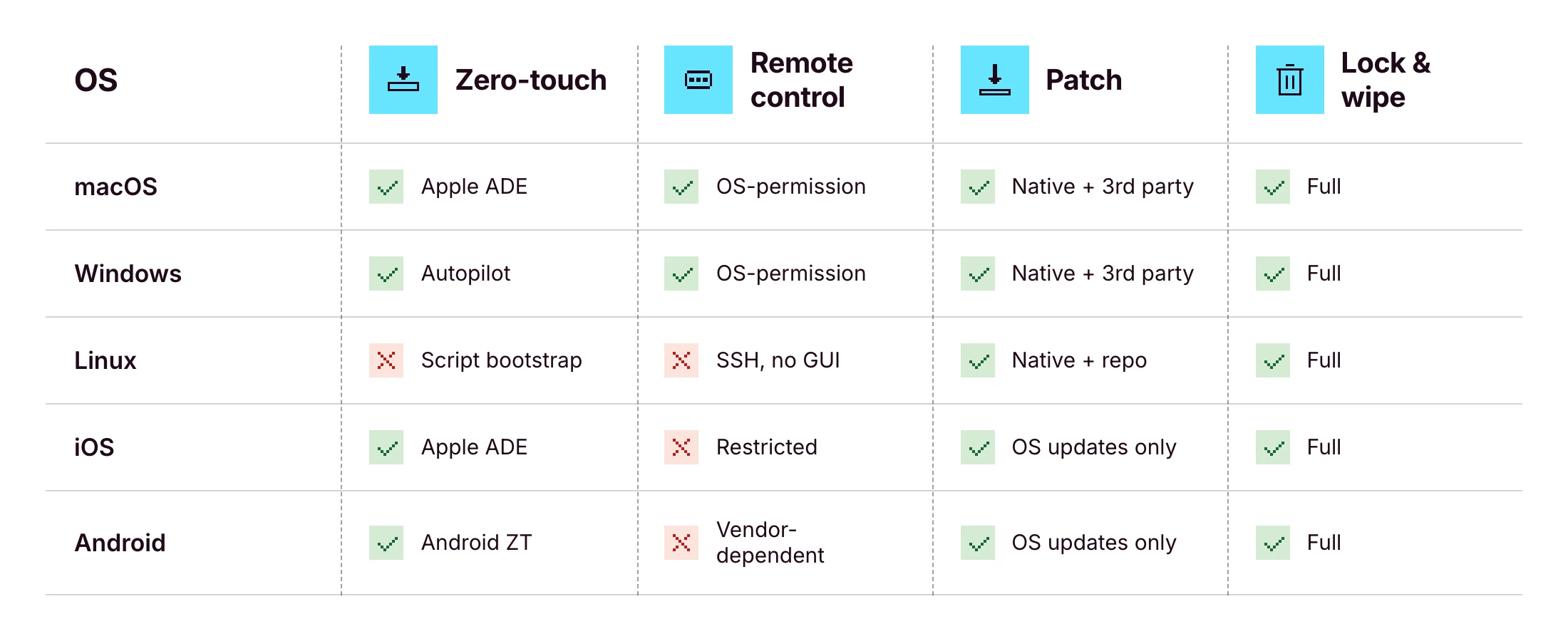
The honest answer: no platform delivers 100% of every cell. iOS unattended remote control is impossible by design. See the Apple Business Manager deployment guide for the underlying constraints, and Microsoft Intune device management docs for the Windows-side equivalents. What you should expect from a serious RDM platform is a unified console for all five operating systems, which Primo states as "Mac, Windows, Linux, iOS, and Android managed from a single interface" — and parity wherever the OS allows it.
The full remote device lifecycle: from procurement to retrieval
Most RDM guides start at enrollment and end at wipe. That's the part of the lifecycle that touches the management console. It's also only half of what IT actually owns.
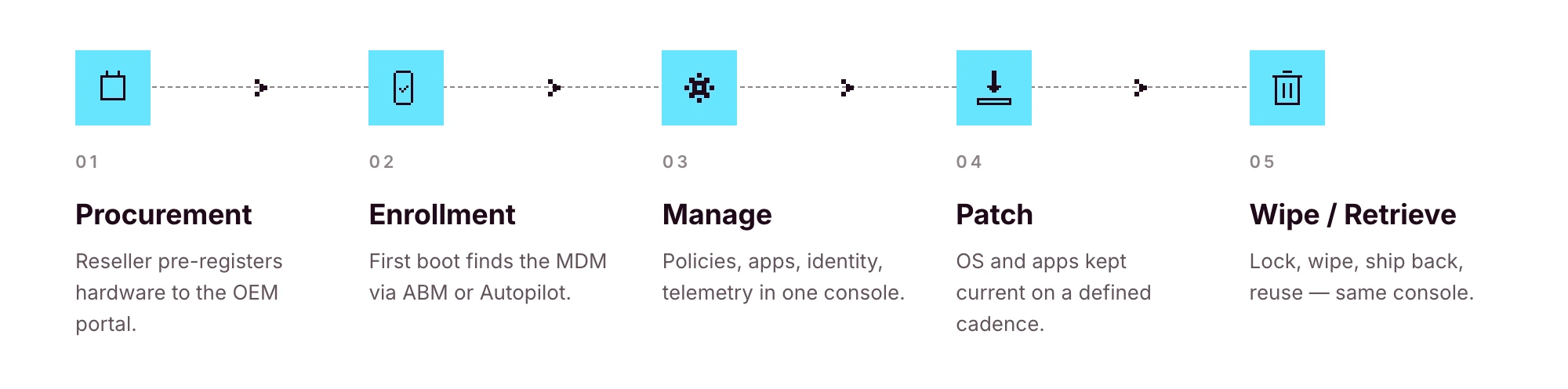
The full picture:
1. Source: purchase from an authorized reseller that can pre-register hardware to the OEM portal
2. Ship: direct-to-employee, ideally with zero IT handling in between
3. Enroll: first power-on, the device finds its MDM through Apple Business Manager or Windows Autopilot
4. Manage: policies, apps, identity, telemetry
5. Patch: OS and app updates on a defined cadence
6. Lock and wipe: on request, on loss, or on exit
7. Retrieve: return label or pickup, ideally triggered automatically
8. Reassign or retire: back into stock for the next hire, or recycled responsibly
If your RDM tool only covers steps 3–6, you're stitching together couriers, OEM portals, reseller order forms and spreadsheets to handle the rest. That stitching is where lean IT teams burn the most time.
Procurement integration is the part most teams don't realize they're missing until they've lived without it. Primo's procurement workflow covers 60+ countries with delivery in around 5 business days, ships devices with apps and security settings pre-configured, and triggers returns and wipes automatically from your HR workflows. That removes steps 1, 2, 7 and 8 from your hands.
Why remote device management breaks at the HR-IT handoff
A new hire is created in your HRIS on Monday. They start three weeks later. Between those two dates, four to seven separate things have to happen on the IT side: order the laptop, create the IdP account, provision the right SaaS apps, assign role-based policies, ship the device, prepare the Day One guide.
If your only trigger is a Slack message from HR, something will slip. Usually not the laptop — laptops are visible. It's the seventh-tier SaaS app the new hire needs in week two, which nobody remembers exists until they ask for access.
Modern RDM treats the HRIS event as the source of truth, then fires the entire downstream workflow:
• HRIS creates the employee record →
• IdP account is provisioned →
• Role-based SaaS access is granted →
• Device is ordered and pre-registered →
• Zero-touch enrollment routes it to the MDM on first power-on →
• Policies and apps deploy automatically
This is the operating model behind Primo's IAM page summary: "HR triggers it. Primo executes it." and "Native integrations with 60+ HRIS, identity providers, and SaaS tools." For lean IT teams, that changes the job description: less ticket execution, more workflow design.
For the practical version of this (phased, role-by-role) read the IT onboarding checklist for lean teams.
A device is offboarded only when access is offboarded too
Wiping the laptop is the easy part.
What about Slack? Google Workspace? HubSpot? Notion? The shared 1Password vault? The GitHub org? The shared admin email for the payments processor?
A device wipe doesn't reclaim SaaS access. The two have to be handled together — and on lean teams, they almost never are. That's the gap that turns into an audit finding six months later: a leaver who still has access to a customer dataset because nobody owned step 4 of the offboarding flow.
Modern RDM platforms treat SaaS access revocation as inseparable from device offboarding. The HRIS exit event that triggers a remote wipe should also revoke IdP access (which cascades through every SSO-connected app), deactivate accounts on apps not behind SSO, reclaim licenses for cost control, and archive shared resources to the right owner. Deprovisioning is a first-class control in NIST SP 800-53 AC-2 (Account Management), not an afterthought.
Primo states this explicitly: "Revoked automatically on their last day to prevent security breach." Identity and device live in the same console, fired from the same HRIS event, on the same schedule — not in two parallel workflows that drift over time.
How to choose a remote device management platform for an SMB
The 10-point checklist that separates platforms built for SMBs from platforms scaled down from the enterprise:
1. Multi-OS coverage: macOS, Windows, Linux, iOS and Android in one console
2. RBAC on the admin console: at least three roles out of the box
3. SSO on the admin console: your IT team's access should die when their identity does
4. HRIS integration: events from systems like BambooHR, HiBob, Factorial, Eurécia, Deel, Dayforce, Charlie, ADP or Gusto trigger downstream workflows
5. Open API and webhooks: anything standard one quarter becomes custom the next
6. Automated patch management: OS and third-party, with deferral windows
7. Procurement integration: sourcing and shipping inside the same operating model
8. Clear vendor jurisdiction and data handling: EU-based vendor for European fleets is a real signal; data-residency claims should be checked in writing
9. Pricing transparency: per-device, monthly, visible without a sales call
10. Time-to-deploy in days, not quarters: if onboarding takes a quarter, it isn't lean-team-fit
Answer "yes" to all ten with the same vendor and you've found your remote device management software. Answer "yes" to nine, and the tenth is the one to negotiate hardest on.
Frequently asked questions
What is remote device management?
Remote device management is the practice of monitoring, configuring, and securing devices from a central console without physical access. IT teams use it to enroll laptops, phones and tablets, push software, enforce security policies, and lock or wipe devices remotely. It applies across macOS, Windows, Linux, iOS and Android.
What is the difference between RDM and MDM?
MDM (mobile device management) historically refers to managing smartphones and tablets. Remote device management is broader and covers any endpoint (laptops, desktops, mobile devices and increasingly IoT) operated remotely. In 2026 the terms overlap, and most modern MDM platforms function as full RDM systems.
How does remote device management work?
A device enrolls into the management platform either manually or through zero-touch deployment. The platform then pushes configuration profiles, apps, and security policies over the air. Admins can remotely view, patch, lock or wipe the device, subject to OS-level permission models. HRIS or IdP integrations can automate enrollment and access changes.
Can one platform manage Mac, Windows, Linux, iPhone and Android?
Yes, but coverage varies by vendor. Apple-only platforms (Jamf, Mosyle) skip Windows and Linux. Cross-platform vendors (Primo, JumpCloud, Intune, Hexnode) support multiple OSes from one console. Verify on the vendor's product page that all five OSes are managed natively, not via third-party agents.
How do you offboard a remote device securely?
Trigger the offboarding workflow from the HRIS. Lock the device, wipe corporate data (full wipe for company-owned, selective approaches for BYOD depending on OS), revoke SaaS and IdP access, send a return label or schedule pickup, then mark the asset for reassignment or retirement in inventory.
What should small businesses look for in remote device management software?
Multi-OS coverage, transparent SMB pricing, HRIS and IdP integrations, RBAC on the admin console, zero-touch deployment support, automated patch management, procurement and shipping integration, clear vendor jurisdiction and data-handling posture, and a time-to-deploy measured in days rather than months.
Is remote device management the same as MDM?
Not exactly. MDM is a subset of remote device management focused historically on mobile. RDM is the broader operational discipline that includes mobile, laptops, desktops, and the workflows around procurement and offboarding. Most modern platforms (UEM, MDM, RDM) functionally overlap.
Primo now has an MCP server.
A device gets flagged. You need to know who it's assigned to, when it was last active, whether there's an open ticket on it, and what access that employee currently has.
You open Primo. You look up the device. You check the employee profile. You cross-reference the ticket queue. You piece it together.
That's four steps for a question that should take one.
Here's the same thing with Primo's MCP server connected to your AI assistant: you type "what's going on with this device?" and get back the device details, the assigned employee, their onboarding status, and any related tickets. One prompt. Full context. No tab-switching.
That's what we shipped.
MCP: Model Context Protocol
MCP (Model Context Protocol) is an open standard that lets AI assistants like Claude, ChatGPT, or Cursor connect directly to external tools. Instead of answering from training data, your AI queries your actual systems in real time.
With Primo's MCP server, that means your AI assistant can talk directly to your IT fleet. Devices, employees, accessories, tickets: all accessible from the AI tools you already have open.
Why it hits differently with Primo
Most IT tools that support MCP give you access to records. Primo gives you access to a connected data model.
Because Primo ties devices, employee lifecycle, SaaS access, and ticketing into one operational system, a single prompt can cross all of those layers at once. When you ask about a device, it comes back linked to an identity. When you ask about an employee, you get their full IT footprint: what they have, what they can access, what's pending.
That's the difference between querying isolated records and querying a unified IT operations platform.
It also means you can get a compliance-ready view of your entire fleet in one prompt. Preparing for an ISO 27001 audit and need to know which devices aren't enrolled or which employees still have active access after offboarding? That's a question your AI can now answer across your whole fleet, not just device by device.
A few things you can do from a single prompt today:
• Pull a device's full IT history (enrollment date, successive assignments) alongside the employee it's assigned to ;
• List all open tickets filtered by status, priority, or assignee ;
• Check which employees joined this month and whether their devices are provisioned ;
• Spot accessories that are unassigned or overdue for return ;
• Search across your entire fleet without opening a single filter.
And when you're ready to move beyond read-only, write access lets you create tickets, add comments, update status and assignee, and perform device actions like locking or wiping directly from your AI client.
What your AI can do in Primo
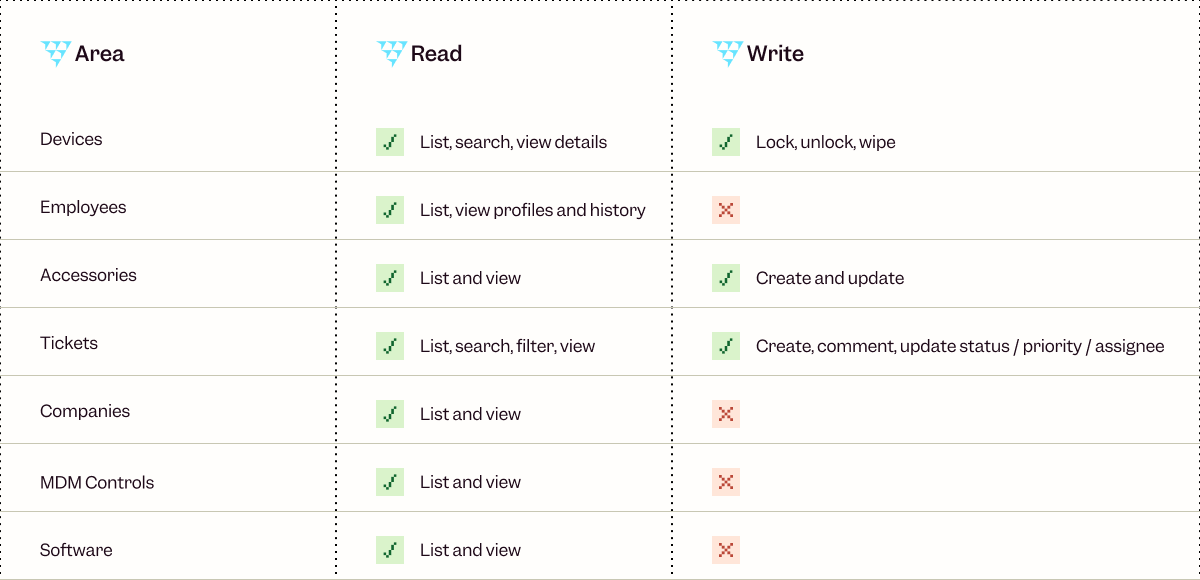
One note on device actions: locking and wiping are irreversible. Write mode is there for teams who want speed, but it's worth confirming before you act.
Getting connected
Authentication runs through OAuth. No API key to generate or manage, you sign in with your existing Primo account and you're done.
The server URL is https://api.getprimo.com/mcp. By default it runs in read-only mode. To enable write access, use https://api.getprimo.com/mcp?readOnly=false.
Setup is the same across clients: go to the MCP Servers section in your settings, add the URL, and complete the OAuth flow. Full instructions for Claude, ChatGPT, and Cursor are in the Primo help center.
A good place to start
Read-only prompts are the fastest way to build trust in the workflow before moving into writes. Try these:
"Show me all devices that haven't been active in the last 30 days."
"What open tickets are currently unassigned?"
"List employees who joined this month and check whether their devices have been provisioned."
Once that feels natural, write access opens up the rest.
The MCP server is live now. Get started at https://api.getprimo.com/mcp, or head to the help center if you want step-by-step setup instructions for your AI client.