What Is Agentic IT? AI for IT Operations, Explained
Agentic. Agents. Copilots. LLMs. MCP. If you run IT, a new piece of vocabulary lands in your feed every few weeks, each one promising to change everything... and honestly most of it turns out to be the tool you already had with a fresh coat of paint. So it's reasonable to see "agentic IT" and assume it's more of the same. Mostly that reflex is earned. But there's a real shift underneath the noise, and it's worth ten minutes to pull it apart from the marketing.
Picture the part of your week you wouldn't miss. A new hire starts Monday, so you order the laptop, enroll it, push the security policies, create the accounts, grant the SaaS licenses, install the apps, then run the whole thing backward the day someone leaves, hoping no account got left open. None of it is hard. All of it is steps. And the steps are what eat the day.
Here's the plain version: agentic IT is software that runs IT operations toward a goal instead of following fixed rules. You hand it the outcome, "get this new hire fully equipped on Day One", and it works out the steps and carries them out itself: order the device, enroll it, apply the policies, provision the accounts, resolve the small problems along the way, and check with you before it does anything it shouldn't. Your current automation runs the script you wrote in advance. An agent decides which script to run, and fills in the parts you didn't write.
For a lean team running 50–2,000 devices across macOS, Windows, Linux, iOS and Android, that's the difference between configuring automations one at a time and delegating a whole workflow to something that already knows your environment.
This guide covers what agentic IT actually means, how it differs from AIOps and from a help-desk chatbot, what an agentic system does day to day, and how to tell a real one from a rebadged one when you evaluate it.
What "agentic" actually means
An AI agent is a system that can perceive a situation, decide on a course of action, and carry it out across tools, with a degree of autonomy. Three properties make something agentic rather than just "AI-powered":
- It works toward a goal, not a single output. You don't prompt it for an answer; you hand it an objective and it sequences the steps to get there
- It can act, not just advise. It reads your data and writes to your systems - enrolling a device, revoking access, opening a ticket - within permissions you set
- It plans across systems. A real IT outcome touches procurement, MDM, identity, SaaS and the help desk. An agent orchestrates across them instead of stopping at one tool's edge
Agentic IT is that pattern applied to IT operations: an agent (or a set of agents) that runs the recurring, multi-step work of equipping, securing and supporting a workforce's devices and accounts.
Agentic IT vs. IT automation
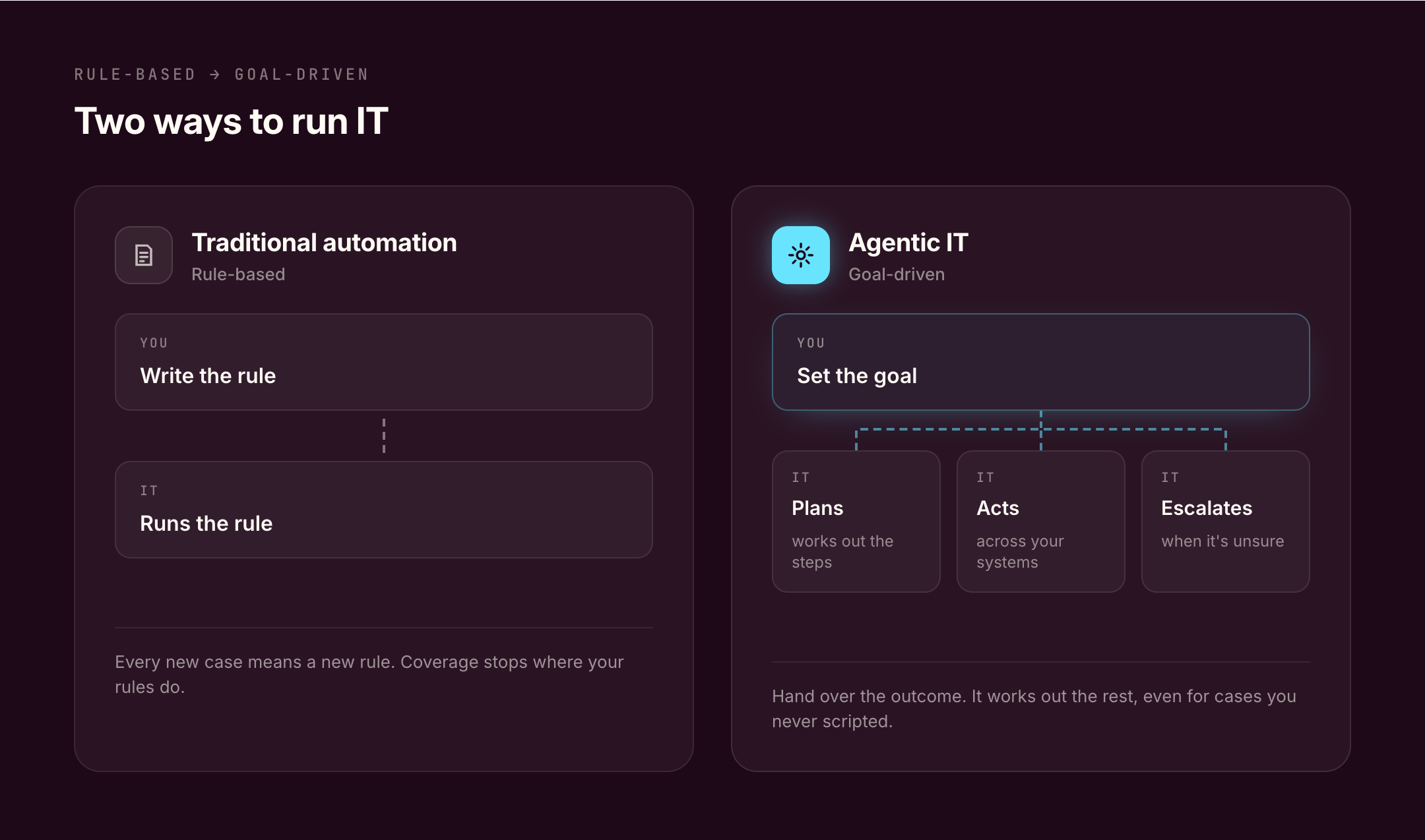
IT automation isn't new,MDM platforms have pushed policies and scripts for years. The difference is who designs the path.
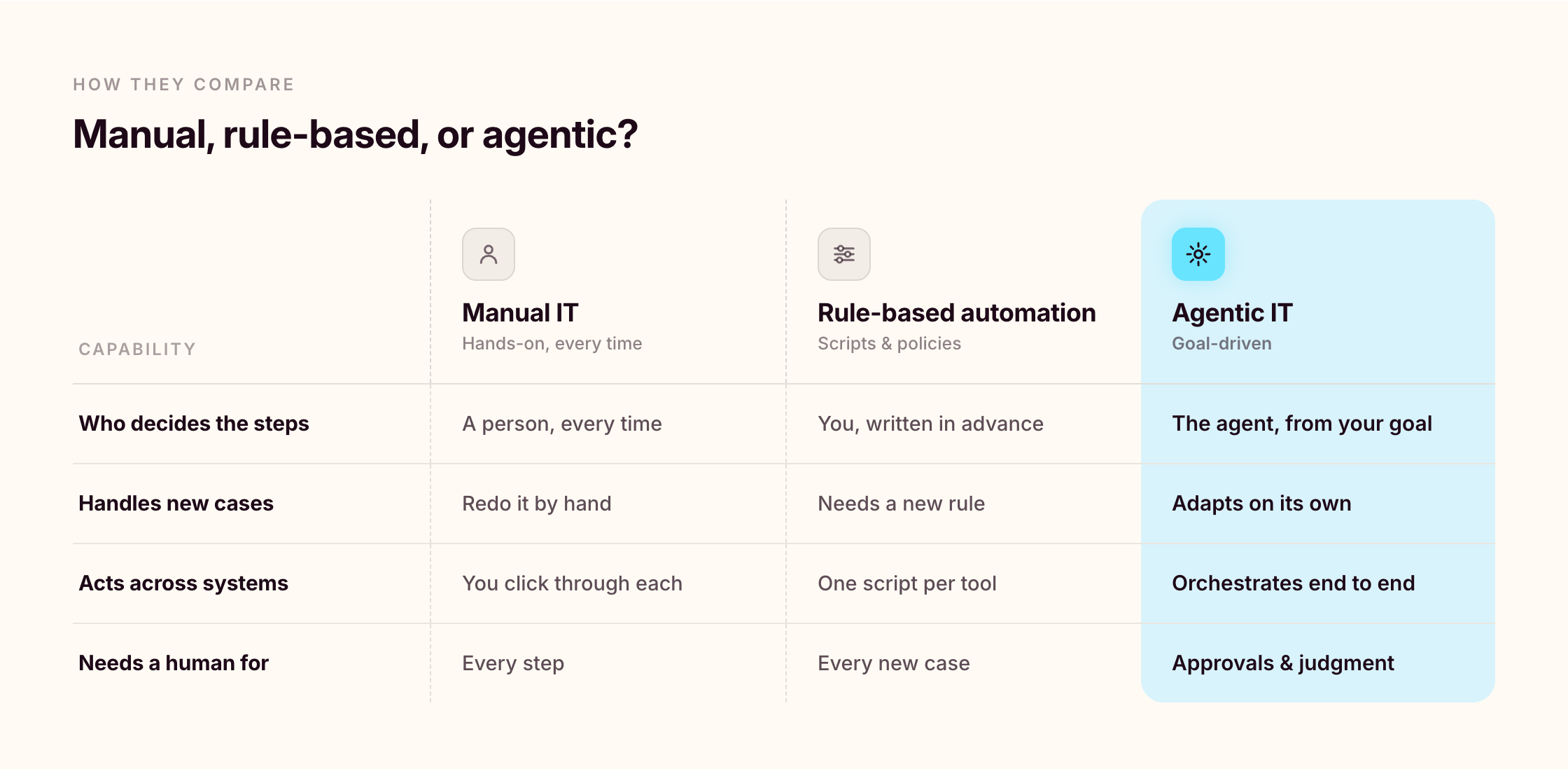
- Automation runs a path you defined. It's deterministic, reliable, and brittle: every new case needs a new rule. Coverage is exactly as wide as the rules you maintained
- Agentic IT is handed the destination and works out the path. It generalizes to cases you didn't pre-script, adapts when something changes (a device is offline, a license is missing), and asks for help when it's unsure
In practice you want both. Automation is the floor: predictable, auditable steps. Agentic IT is the layer above it that decides which automations to fire, in what order, and what to do when reality doesn't match the script.
Agentic IT vs. AIOps
If you've researched this, you've hit the term AIOps (AI for IT operations). It's worth separating, because most AIOps content is written for a different buyer than you.
- Classic AIOps grew up in large enterprises and data-center / network operations: ingest huge volumes of telemetry and alerts, use ML to correlate them, suppress noise, and detect anomalies. The job is observability at scale — and the audience is SRE and NOC teams running thousands of servers.
- Agentic IT, in the sense most growing companies need it, is about the workplace IT a 1–10 person team owns: laptops and phones, onboarding and offboarding, security posture, access and licenses, day-to-day support. The agent doesn't just spot a problem — it resolves it end to end.
So "AI for IT operations" can mean either thing. If a tool's examples are about anomaly detection on server logs, it's solving the data-center problem. If they're about getting a new hire's Mac ready or flagging an unpatched fleet, it's solving yours.
What an agentic IT system actually does
Strip away the framing and an agentic IT system does five concrete things for a lean team:
- End-to-end onboarding and offboarding. Triggered by an HR event (a new hire, a departure), it runs the whole chain: order or assign the device, enroll it, apply role-based policies, create and grant the right accounts, install the apps — then mirror all of it in reverse when someone leaves, so no access is left open.
- Predictive device management. It reads device telemetry continuously and flags what's about to become a problem: a firewall gap, battery wear, a fleet falling behind on patches — before it turns into a ticket.
- Autonomous issue resolution. For the common, well-understood requests ("I need access to X", "my disk encryption isn't reporting"), it resolves the request itself inside guardrails, instead of routing it to a human queue.
- Answers over your live IT data. You ask it questions in plain language — "Which users still need VPN licenses?", "How many macOS devices are unpatched?" — and it answers from the current state of your fleet, not a stale spreadsheet.
- Suggested workflows. It proposes the next sensible action and the full sequence behind it — onboarding → procurement → configuration → install — so a one-person IT team operates like a larger one.
[Visual: GIF of the agent running an onboarding chain (device → enrollment → policies → accounts → apps). Alt: "Agentic IT assistant running a full IT onboarding workflow end to end."]
Where to start
The value concentrates where the work is repetitive, multi-step, and spread across systems — which is why onboarding and offboarding is almost always the first workflow worth handing to an agent: it's deadline-bound, error-prone, and touches procurement, devices, identity and apps at once. Fleet hygiene — patch, encryption and posture — and license clean-up follow naturally. If your IT runs across remote, multi-OS devices, that's exactly the surface agentic IT was built for. Applied to device enrollment, security posture and patching, that same shift is called AI device management.
What to look for when you evaluate agentic IT
The category is young and the labels are loose: "AI", "copilot" and "agent" get used interchangeably. Five questions cut through it:
- Does it act, or only suggest? Many "AI" features are a chat box that drafts a script you still run yourself. Ask what the agent can do autonomously, and what stays human-approved
- What's the human-in-the-loop model? A trustworthy agent is explicit about what it does on its own, what it asks permission for, and how you audit every action it took. Autonomy without an audit trail is a liability
- Does it connect to your HR data? The highest-leverage IT actions are triggered by people events - joins, moves, leaves. An agent wired into HRIS data acts on the real trigger; one that isn't waits for a ticket
- Does it span the whole lifecycle, or one slice? Some tools agent-ify ticket triage; some, patching; some, scripting. The end-to-end value comes from one agent that reaches across procurement, MDM, identity and support
- Multi-OS and identity in scope? If you run Mac and Windows and mobile, an agent that only understands one OS, or only devices and not accounts, leaves half the work manual
An honest note on fit. If you're a large enterprise with a dedicated SRE/NOC function and your core pain is correlating server and network telemetry at scale, a classic AIOps platform (Datadog, Dynatrace, LogicMonitor) is the right tool, not workplace agentic IT. If you're an MSP managing many client estates, RMM-first agents (Atera, NinjaOne) are built for that shape. Agentic IT in the sense this guide describes fits best when one small team owns the devices, accounts and support for a 50–2,000-person company and wants to operate above its headcount.
What agentic IT is not
Three guardrails worth stating plainly, because they're where the trust is won or lost:
- It's not "fire IT and let the bot run." It's leverage for the team you have becauseit removes the repetitive multi-step work, not the judgment
- It's not a black box. A credible agentic system shows its work: what it decided, why, and what it changed. If you can't audit it, you can't trust it with production access
- It's not unbounded autonomy. The agent operates inside the permissions and approval gates you set. The good ones make those gates easy to see and adjust
How Primo approaches agentic IT
Primo is the IT control layer for modern companies: MDM, SaaS management, ticketing and device procurement in one place, connected to your HR data. Primo's AI agent runs on top of it.
What makes the approach specific rather than generic:
- It's wired to HR data. Joins, moves and leaves trigger the right IT actions :most agents wait for a ticket whilePrimo's agent acts on the real event
- It's end-to-end. One agent reaches across procurement → enrollment → configuration → install → support, instead of automating a single slice
- It's multi-OS, with identity and procurement in scope. Mac, Windows, Linux, iOS and Android; devices and accounts and the hardware supply chain, not just one of them
- Its data is queryable by other AI assistants. Primo exposes a Model Context Protocol (MCP) server, so an AI assistant can ask Primo about your IT estate directly. That's a genuinely open, agent-native posture few MDM vendors have
For the bigger picture on where AI is taking IT operations, see our take on what's happening in AI and what it means for agentic IT. And if you want to see an agent run a real IT workflow end to end, explore Primo's AI agent or book a demo.
Frequently asked questions
What is agentic IT?
Agentic IT is software that runs IT operations toward goals rather than following fixed rules. Given an objective — like fully equipping a new hire — an AI agent plans and executes the steps across procurement, device management, identity and support, acting on your live IT and HR data and escalating to a human when needed.
What's the difference between agentic IT and AIOps?
AIOps traditionally means using AI to correlate telemetry and detect anomalies at scale, built for enterprise data-center and network teams. Agentic IT, as growing companies use it, applies AI agents to workplace IT - onboarding, device security, access and support - and resolves issues end to end rather than only detecting them.
Is agentic IT the same as IT automation?
No. Automation runs a path you defined in advance and needs a new rule for every new case. Agentic IT is given the destination and works out the path itself, adapting to cases you didn't pre-script and asking for approval when it's unsure. Most teams use both: automation as the reliable floor, an agent as the layer that decides which automations to run and when.
Does agentic IT replace the IT team?
No. It removes repetitive, multi-step work so a small team operates above its headcount. The judgment, the approvals and the audit stay with people, a credible agentic system is explicit about what it does autonomously and what it asks permission for.
What should a small IT team look for in an agentic IT tool?
Whether it acts or only suggests; a clear human-in-the-loop and audit model; a connection to HR data so it acts on real people-events; end-to-end lifecycle coverage rather than one slice; and multi-OS plus identity in scope.