

Quick answer: which Iru alternative fits your team?
Iru is the new name of Kandji (rebranded in October 2025). It remains one of the strongest choices for Apple-only depth. If that is your need, staying on Iru is a fair call. Teams usually switch when they run Macs alongside Windows and mobile, or when they want onboarding, SaaS access and day-to-day IT handled by one platform.
- Multi-OS SMB that wants one platform (MDM + SaaS + HRIS automation): Primo. Device management, SaaS access and IT ticketing in one tool, with onboarding and offboarding driven by your HRIS.
- Apple-only with enterprise depth: Jamf Pro, or simply stay on Iru.
- Standardized on Microsoft 365: Microsoft Intune.
- Straightforward Apple management on a budget: Mosyle.
- Device management plus directory and identity: JumpCloud.
- HR, payroll and IT from one vendor: Rippling IT (strongest if Rippling is already your HRIS).
Introduction
If you’re searching for the best Iru alternative in 2026, you’re likely managing a growing Mac fleet and want something simpler, more automated, or more complete than a “pure MDM”.
If you want a quick overview of Primo’s device management capabilities, see Primo MDM.
For Mac-first SMBs, the gap is usually the same: device management is only one piece of the employee IT lifecycle. Teams also need automated onboarding/offboarding, SaaS access and spend visibility, and enough security + compliance features to stay audit-ready without adding more tools.
This guide compares the top alternatives to Iru (from all-in-one platforms to best-in-class MDMs), so you can choose the right fit for your team.
Overview
Iru is Kandji: the company rebranded in October 2025 as it broadened from Apple MDM toward AI-assisted IT operations, shipping Iru AI on top of Kandji’s Apple-first foundation. If you were comparing “Kandji alternatives” last year, this is the same comparison under a new name. A rebrand is also a natural moment to re-read your contract, the roadmap and the pricing.
As companies scale, they often need one (or more) of the following:
- A platform that connects MDM to HRIS-driven workflows (joiners/movers/leavers)
- SaaS management to control licenses, shadow IT, and access
- Built-in IT ticketing or better operational workflows
- Faster deployment and lower admin overhead for lean IT teams
Below are the best Iru alternatives in 2026, plus options that can replace a broader “IT operations” tool category if you’re evaluating Iru.
Why Companies Look for an Iru Alternative
Iru can be a strong option, but it’s not always the best match when teams want to consolidate tools or automate cross-functional workflows.
Common reasons teams switch:
- You want HRIS-connected onboarding/offboarding out of the box
- You need SaaS management (app inventory, access, license optimization)
- You want one platform instead of stacking MDM + SaaS + ticketing
- Your IT team is small and needs something fast to deploy and easy to run day to day
- You need more flexibility for mixed environments (Mac + Windows) as you grow
1. Primo: The Best All-in-One Alternative (MDM + SaaS + HRIS Automation)
Best overall for Mac-first SMBs that want to consolidate tools
Primo is an all-in-one IT management platform designed for SMBs (typically 50 to 700 employees). It covers macOS management like an MDM, but goes further by tying device management to the full employee IT lifecycle.
Why Primo is often a strong alternative to Iru for growing teams:
- HRIS integrations (PayFit, Factorial, Personio, BambooHR, Workday, etc.) to automate joiners/leavers
- SaaS management included: application inventory, unused license detection, shadow IT visibility
- Built-in IT ticketing with device context
- Zero-touch provisioning via Apple Business Manager
In practice, that means: when an employee is created in your HR system, Primo can automatically provision the Mac and required apps. When they leave, access and devices can be secured quickly, without manual checklists.
On the AI front, both platforms are moving: Iru ships Iru AI, focused on Apple administration; Primo ships an AI agent that runs IT operations across the whole lifecycle (onboarding, fleet remediation, access requests) on Mac, Windows and mobile, wired to your HRIS. If that angle matters to your evaluation, see our guide to AI device management.
Key features
- macOS MDM with Apple Business Manager enrollment
- Automated onboarding/offboarding workflows connected to HRIS
- SaaS inventory + license optimization
- Integrated IT ticketing
- Fast deployment for lean IT teams
Best fit for
- Mac-first SMBs that want MDM + SaaS + automation in one platform
- IT teams of 1 to 20 people trying to reduce tool sprawl
- Teams that want onboarding/offboarding to be mostly automatic
Not a great fit for
- Large enterprises committed to heavyweight ITSM platforms
- Organizations that need extremely deep, niche Apple configuration beyond standard MDM coverage
2. Jamf Pro: Apple Management at Enterprise Depth
Best for Apple-first teams that want maximum MDM power
Jamf is the classic reference for Apple device management. If your decision is primarily “best Apple MDM”, Jamf remains a top contender.
Compared to more lightweight Apple-first tools, Jamf often wins on ecosystem maturity and depth. The tradeoff is complexity and (often) higher overhead.
Key features
- Deep macOS/iOS configuration and policy controls
- Strong Apple ecosystem support and integrations
- Mature app deployment + security baselines
Best fit for
- Apple-heavy orgs with experienced IT admins
- Teams that want maximum flexibility and control
Not a great fit for
- Very small IT teams seeking a lightweight, low-admin solution
- Teams that want SaaS management and HR automation included in the same platform
3. Microsoft Intune: A Strong Option for Microsoft 365 Environments
Best for Windows-first or mixed environments standardized on Microsoft
If your company is standardized on Microsoft 365, Intune can be a cost-effective choice. It handles Windows extremely well and offers functional macOS management.
For Mac-first teams, Intune is usually considered when consolidating around the Microsoft stack is a priority.
Key features
- Windows-first MDM with macOS support
- Conditional access policies via Entra ID
- Integrations with Microsoft security tooling
Best fit for
- SMBs already deeply invested in Microsoft 365
- Mixed OS environments where Windows is significant
Not a great fit for
- Mac-first teams wanting Apple-native management experience
- Teams looking for built-in SaaS management and HRIS automation
4. Mosyle: Cost-Effective Apple Management
Best for budget-sensitive teams managing Apple devices
Mosyle is widely used for Apple management, especially in education but also for SMBs. It can be a strong option when price and straightforward Apple management are the main drivers.
Key features
- macOS/iOS management with common policy controls
- App deployment and configuration profiles
- Competitive pricing
Best fit for
- Teams that want an affordable Apple MDM
- Organizations with relatively standard Mac management needs
Not a great fit for
- Teams wanting deeper automation across HR + SaaS + IT operations in one place
5. JumpCloud: Directory + Device Management Combined
Best for teams also rethinking identity and access
JumpCloud combines a cloud directory (SSO/MFA, device trust) with device management across macOS and other OSes. If you’re evaluating Iru as part of a broader IT operations overhaul, JumpCloud can be relevant, especially if you want to modernize identity and device control together.
Key features
- Cloud directory with SSO/MFA
- Cross-platform device management
- Policy enforcement tied to identity
Best fit for
- SMBs without a mature identity provider who want a unified approach
- Remote-first teams with mixed device environments
Not a great fit for
- Teams that only want best-in-class Apple MDM
- Organizations already standardized on Okta or Azure AD and not looking to change
6. Rippling IT: Best When HR and IT Are Owned by the Same Platform
Best for companies already using Rippling as HRIS
Rippling’s IT features are strongest when you use Rippling for HR. In that setup, onboarding/offboarding workflows are naturally connected.
If you have a different HRIS, the “single-platform” advantage becomes smaller.
Key features
- HR-driven onboarding/offboarding for devices and accounts
- Device management integrated into the Rippling platform
- Centralized employee lifecycle workflows
Best fit for
- Teams already on Rippling HRIS who want IT workflows tightly integrated
Not a great fit for
- Companies not using Rippling as their HRIS
- Teams looking for an HRIS-agnostic solution
How to Choose the Right Alternative
To choose the right Iru alternative, answer these questions:
- Do you need just MDM, or MDM + SaaS + onboarding/offboarding automation?
- Are you Mac-first, or do you need strong coverage for Windows too?
- Do you want to consolidate tools, or replace only your MDM?
- What’s your team size, and how much admin time can you realistically spend maintaining policies and workflows?
For many Mac-first SMBs, the best long-term outcome comes from reducing tool sprawl: pairing strong device management with SaaS visibility and HR-driven automation in one place.
Iru and its alternatives: quick comparison (2026)
A quick recap of the platforms covered in this guide: OS coverage, and what each one includes beyond device management.
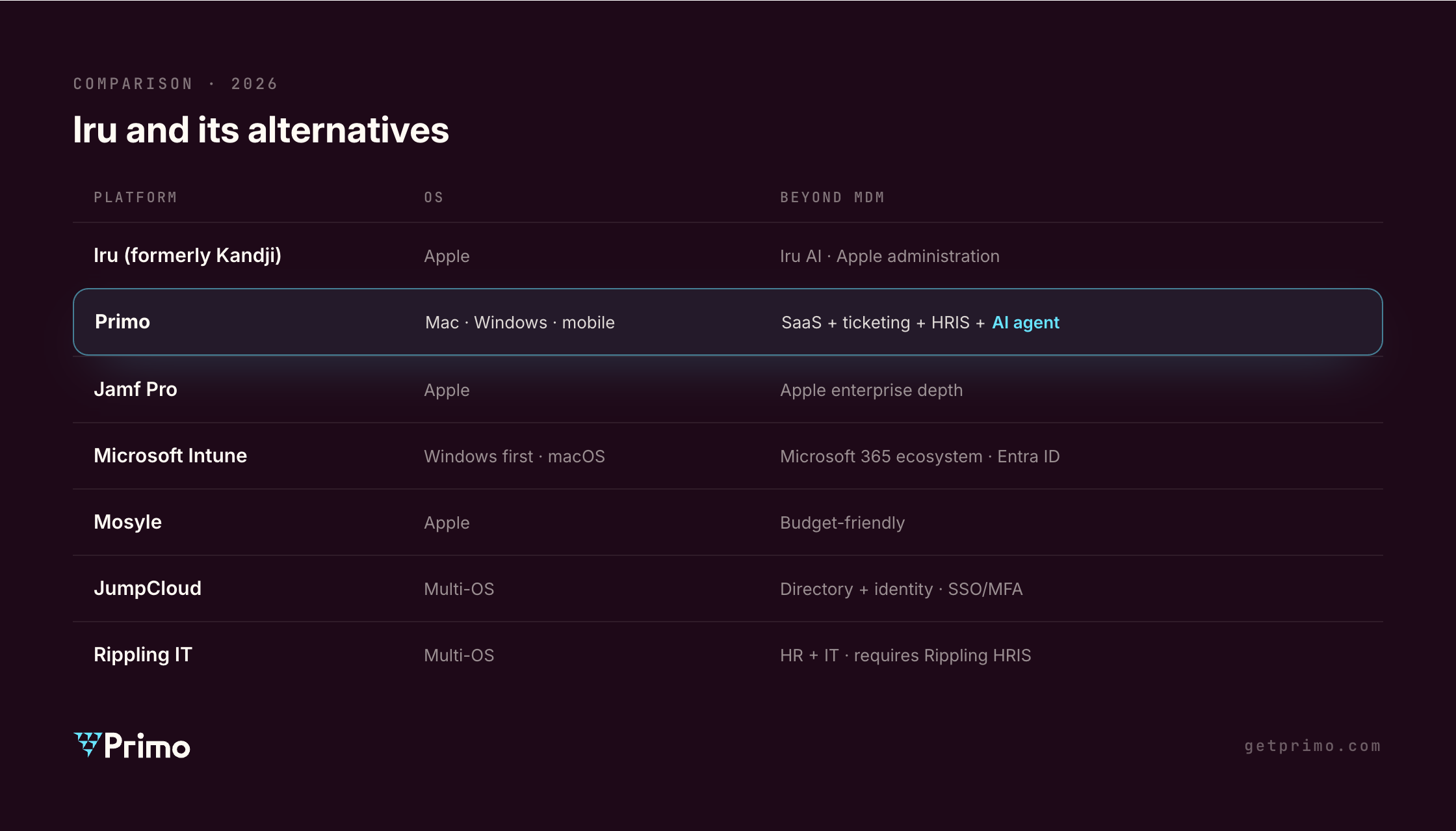
- Iru (formerly Kandji): Apple only (macOS, iOS, iPadOS). Best for Apple-only teams happy with their current setup. Beyond MDM: Iru AI, focused on Apple administration.
- Primo: Mac, Windows and mobile. Best for Mac-first, multi-OS SMBs that want one platform. Beyond MDM: SaaS management, IT ticketing, HRIS-driven onboarding/offboarding, an AI agent across the IT lifecycle.
- Jamf Pro: Apple only (macOS, iOS, iPadOS). Best for Apple-first orgs with experienced IT admins. Beyond MDM: deep Apple ecosystem integrations and security baselines.
- Microsoft Intune: Windows first, macOS supported. Best for companies standardized on Microsoft 365. Beyond MDM: conditional access via Entra ID, Microsoft security tooling.
- Mosyle: Apple only (macOS, iOS, iPadOS). Best for budget-sensitive Apple management. Beyond MDM: competitive pricing, standard policy controls.
- JumpCloud: cross-platform (macOS, Windows, Linux). Best for teams modernizing identity and devices together. Beyond MDM: cloud directory with SSO/MFA, identity-tied policies.
- Rippling IT: cross-platform. Best for companies already on Rippling HRIS. Beyond MDM: HR-driven lifecycle workflows (requires Rippling HRIS).
Conclusion
Tools like Iru can be appealing for teams seeking a modern, simplified approach. For Apple-only depth, staying on Iru is a legitimate choice. But when you factor in onboarding/offboarding, SaaS access, and day-to-day IT operations, many teams outgrow a device-only tool.
In 2026, the best alternatives are the ones that either:
- Deliver best-in-class Apple management (Jamf, Mosyle), or
- Help SMB IT teams consolidate device management, SaaS management, and HRIS-driven automation in one platform (like Primo).
FAQ
Is Iru the same as Kandji?
Yes. Kandji rebranded to Iru in October 2025, as the company expanded from Apple device management toward AI-assisted IT operations (including Iru AI). The product keeps Kandji’s Apple-first depth, and the existing product and customer base continue under the new name.
What is the best Iru alternative for SMBs?
For Mac-first SMBs that want to consolidate tools and automate onboarding/offboarding, Primo is often the best overall option. For Apple-only device management depth, Jamf is a leading alternative.
Is Intune a good alternative to Iru?
Intune is a strong option if your company is standardized on Microsoft 365 or you have a Windows-heavy environment. For Mac-first teams, Apple-native MDM tools often feel more polished.
Can I replace Iru with a platform that also handles SaaS access?
Yes. Some platforms combine device management with SaaS management and HRIS-driven automation, helping SMBs reduce tool sprawl and streamline onboarding/offboarding.
What should I prioritize when switching from Iru?
Most teams should prioritize: ease of deployment, macOS management quality, automation for joiners/leavers, and whether SaaS visibility and license optimization are included or require additional tools.