

Agentic. Agents. Copilots. LLMs. MCP. If you run IT, a new piece of vocabulary lands in your feed every few weeks, each one promising to change everything... and honestly most of it turns out to be the tool you already had with a fresh coat of paint. So it's reasonable to see "agentic IT" and assume it's more of the same. Mostly that reflex is earned. But there's a real shift underneath the noise, and it's worth ten minutes to pull it apart from the marketing.
Picture the part of your week you wouldn't miss. A new hire starts Monday, so you order the laptop, enroll it, push the security policies, create the accounts, grant the SaaS licenses, install the apps, then run the whole thing backward the day someone leaves, hoping no account got left open. None of it is hard. All of it is steps. And the steps are what eat the day.
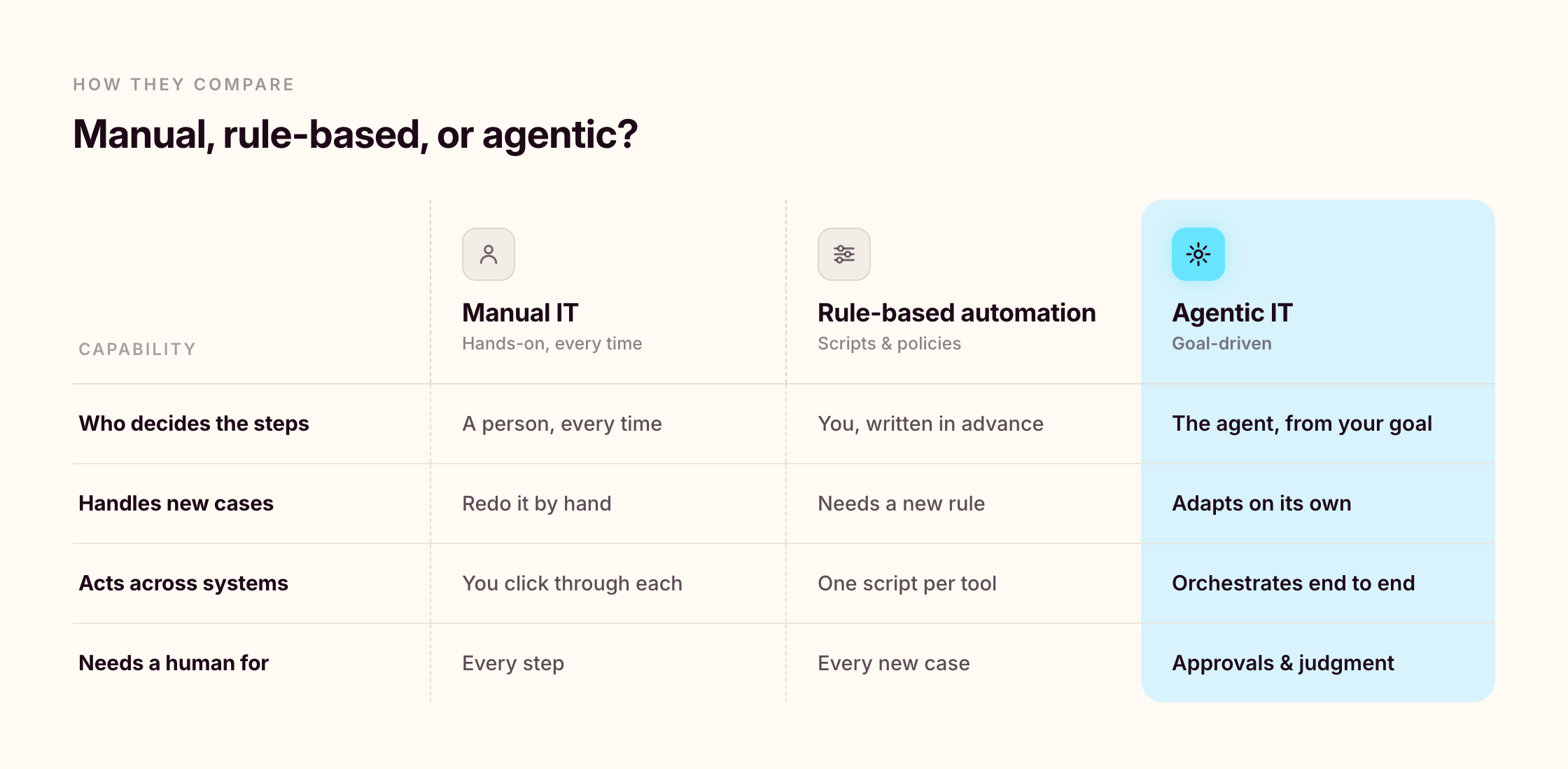
Here's the plain version: agentic IT is software that runs IT operations toward a goal instead of following fixed rules. You hand it the outcome, "get this new hire fully equipped on Day One", and it works out the steps and carries them out itself: order the device, enroll it, apply the policies, provision the accounts, resolve the small problems along the way, and check with you before it does anything it shouldn't. Your current automation runs the script you wrote in advance. An agent decides which script to run, and fills in the parts you didn't write.
For a lean team running 50–2,000 devices across macOS, Windows, Linux, iOS and Android, that's the difference between configuring automations one at a time and delegating a whole workflow to something that already knows your environment.
This guide covers what agentic IT actually means, how it differs from AIOps and from a help-desk chatbot, what an agentic system does day to day, and how to tell a real one from a rebadged one when you evaluate it.
What "agentic" actually means
An AI agent is a system that can perceive a situation, decide on a course of action, and carry it out across tools, with a degree of autonomy. Three properties make something agentic rather than just "AI-powered":
- It works toward a goal, not a single output. You don't prompt it for an answer; you hand it an objective and it sequences the steps to get there
- It can act, not just advise. It reads your data and writes to your systems - enrolling a device, revoking access, opening a ticket - within permissions you set
- It plans across systems. A real IT outcome touches procurement, MDM, identity, SaaS and the help desk. An agent orchestrates across them instead of stopping at one tool's edge
Agentic IT is that pattern applied to IT operations: an agent (or a set of agents) that runs the recurring, multi-step work of equipping, securing and supporting a workforce's devices and accounts.
Agentic IT vs. IT automation
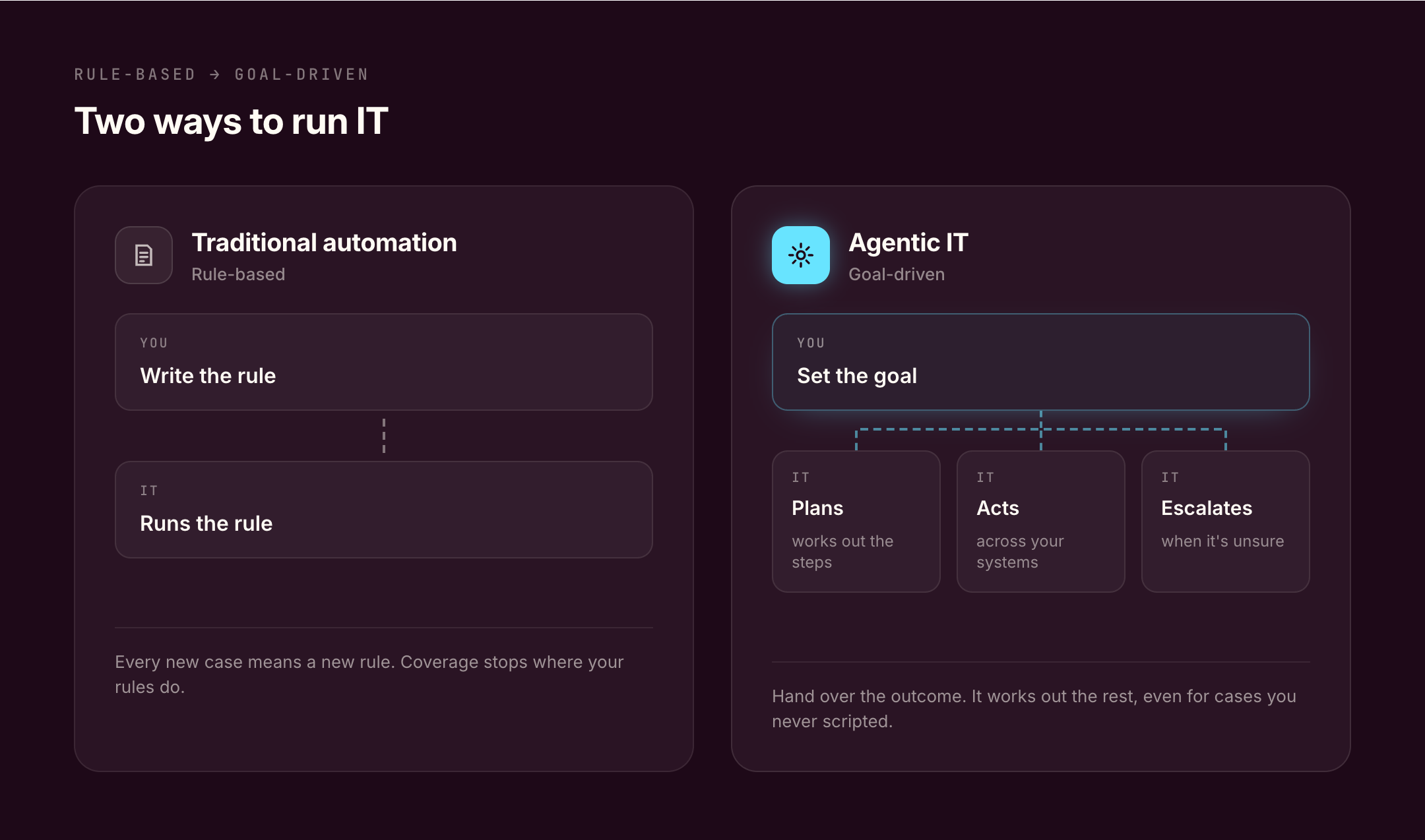
IT automation isn't new,MDM platforms have pushed policies and scripts for years. The difference is who designs the path.
- Automation runs a path you defined. It's deterministic, reliable, and brittle: every new case needs a new rule. Coverage is exactly as wide as the rules you maintained
- Agentic IT is handed the destination and works out the path. It generalizes to cases you didn't pre-script, adapts when something changes (a device is offline, a license is missing), and asks for help when it's unsure
In practice you want both. Automation is the floor: predictable, auditable steps. Agentic IT is the layer above it that decides which automations to fire, in what order, and what to do when reality doesn't match the script.
Agentic IT vs. AIOps
If you've researched this, you've hit the term AIOps (AI for IT operations). It's worth separating, because most AIOps content is written for a different buyer than you.
- Classic AIOps grew up in large enterprises and data-center / network operations: ingest huge volumes of telemetry and alerts, use ML to correlate them, suppress noise, and detect anomalies. The job is observability at scale — and the audience is SRE and NOC teams running thousands of servers.
- Agentic IT, in the sense most growing companies need it, is about the workplace IT a 1–10 person team owns: laptops and phones, onboarding and offboarding, security posture, access and licenses, day-to-day support. The agent doesn't just spot a problem — it resolves it end to end.
So "AI for IT operations" can mean either thing. If a tool's examples are about anomaly detection on server logs, it's solving the data-center problem. If they're about getting a new hire's Mac ready or flagging an unpatched fleet, it's solving yours.